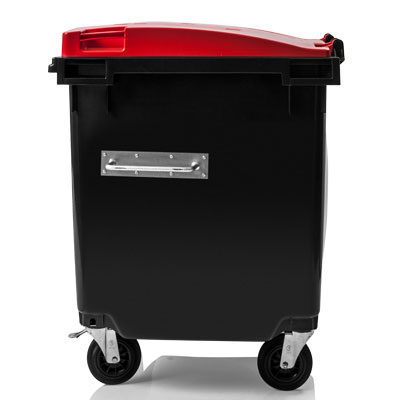
Weber supplies a complete range of factory-fitted options for 2- and 4-wheel plastic waste containers. All special options are manufactured at the Haan production site and are available for the entire Weber range from 60 L to 1100 L.
Equip your Weber 2- and 4-wheel mobile waste containers with high-quality special options for individual requirements. All versions are available directly from the manufacturer and can be freely combined with all Weber container sizes from 60 L to 1100 L.
Lock systems for Weber plastic wheelie bins and waste containers
Wheelie bin locks – practical solutions to protect against unauthorised access and spillage
Weber offers a range of lid locks for 2- and 4-wheel waste containers. The choice of lock system depends on customer requirements regarding logistics, key concept and area of use. Residential complexes, commercial sites and public collection points place different demands on lid security. All lock systems listed here are available as factory-fitted options directly from Weber.
Lock function: with or without automatic release
Lock function · automatic
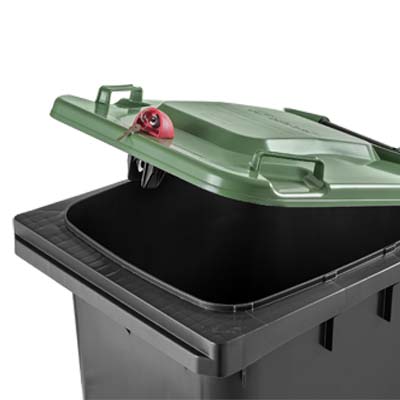
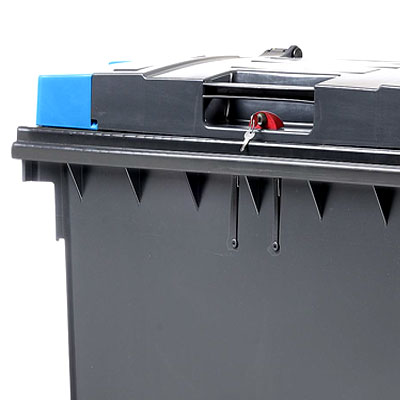
Gravity lock with automatic function
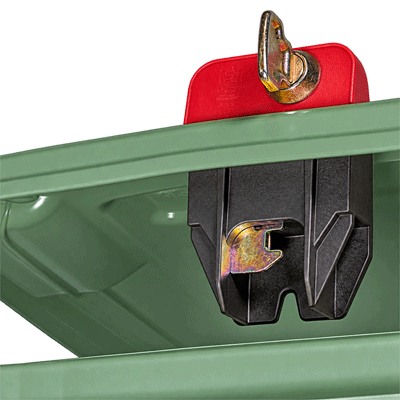
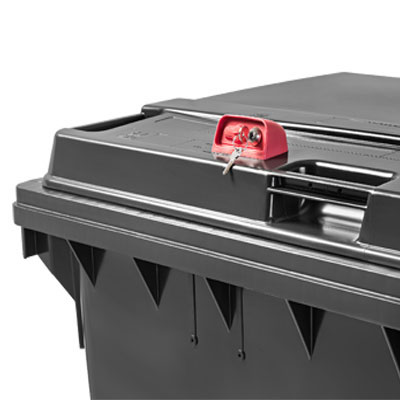
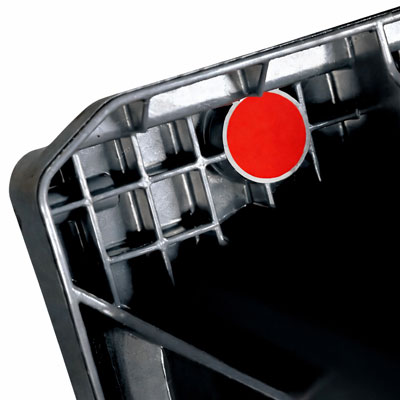
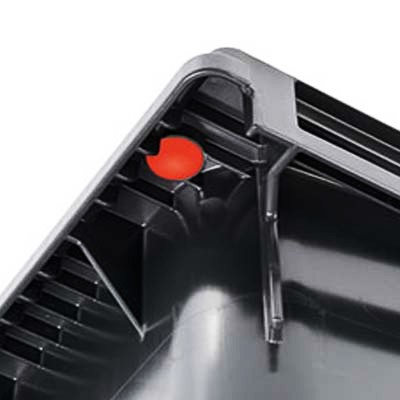
Identifiable by the red signal colour
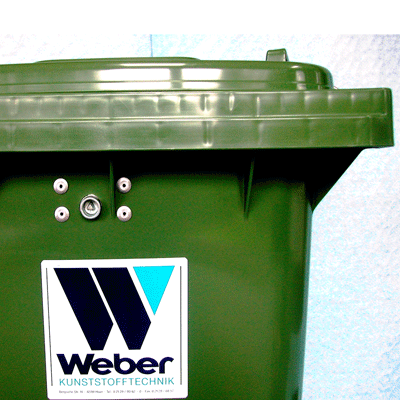
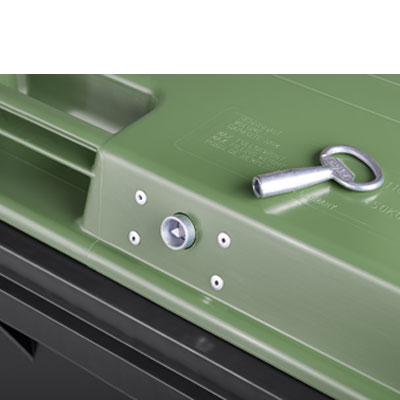
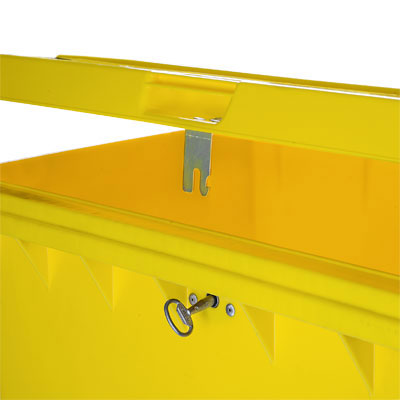
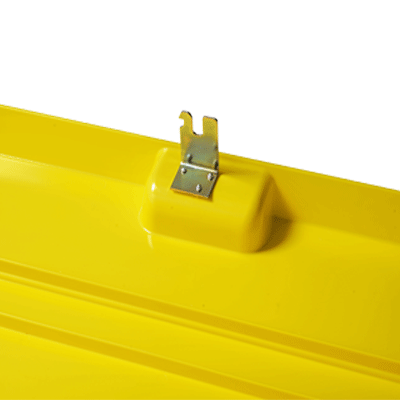
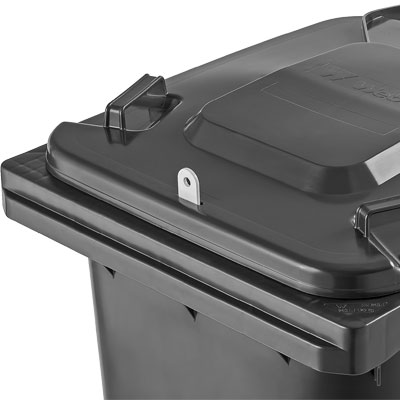
Gravity lock with automatic function – 2-wheel wheelie binsGravity lock – upper lid part with key and lower lid partGravity lock with automatic function – 4-wheel waste containers
Protection against unauthorized access, animals and heavy winds and storm gusts.
The gravity lock engages mechanically as soon as the lid is closed. No key is needed to lock it; the lid locks under its own weight. The user opens it with a key. The bin also stays locked if it is accidentally knocked over. Where waste is weighed and charged by weight, the lock protects your own bin from being used by others.
When tipped beyond 90°, i.e. in the bin lifter, the container opens automatically and releases its contents for emptying.
The gravity function is an additional component inside the container body, with a cylinder lock with automatic function.
Available for Weber 2- and 4-wheel wheelie bins from 60 L to 1100 L.
Lock function · manual
Locks without automatic function
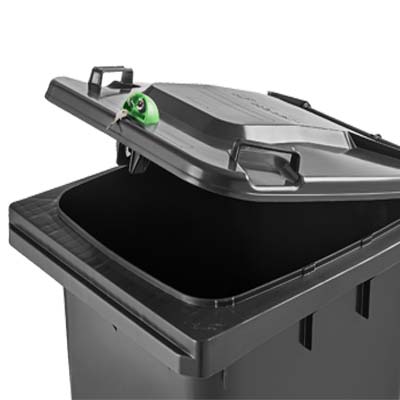
Identifiable by the green signal colour
Lock without automatic function – 2-wheel wheelie bins
The manual lock also ensures secure closure, but without the automatic opening function, e.g. to protect confidential documents. Unlike locks with a gravity function, it must be unlocked by the collection crew before emptying.
Locking types
Locking type · triangular
Triangular lock – open/close version and snap lock
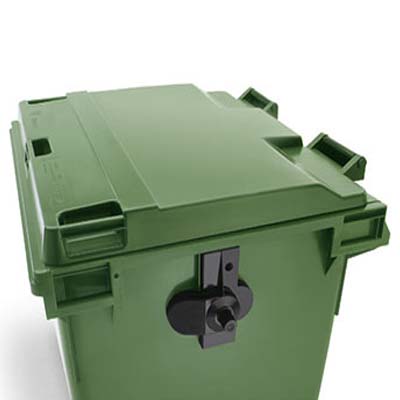
Triangular lock – 2-wheel wheelie binsTriangular lock – 4-wheel waste containersTriangular lock with snap function – 4-wheel waste container, flat lidTriangular lock with snap function – lower lid part
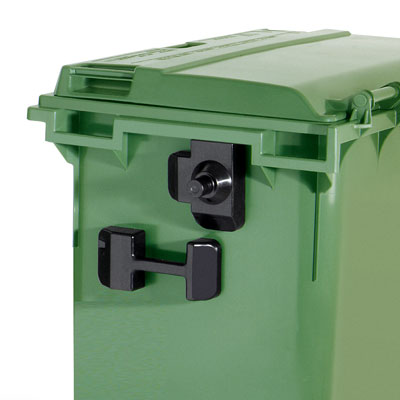
The triangular lock cylinder accepts standardised triangular keys, as used by municipal waste management companies. The metal housing is corrosion-protected; the functional parts and the triangular key are made of metal. The triangular lock is also very well suited to municipal litter bins and similar receptacles.
Open/close version: must be actively locked.
Snap lock: locks automatically once the key is removed.
Available for all Weber 2- and 4-wheel waste containers from 60 L to 1100 L.
Locking type · profile cylinder
Profile cylinder lock
Profile cylinder lock – 4-wheel waste containers
The profile cylinder lock is available in combination with the automatic lock or with the lock without automatic function. The profile cylinder accepts standard profile keys and allows more individual key authorisation than a triangular lock. This version is suitable for containers holding confidential documents, pharmaceutical waste or waste streams with restricted access. The cylinder is replaceable and can be integrated into a master key system for a container fleet. Keyed-alike and keyed-different systems are available.
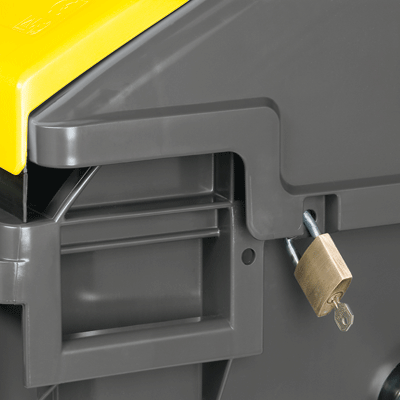
The padlock bracket allows the operator to use their own padlock to secure the lid. This option suits sites without a uniform standard key system, such as waste collection points and areas for hazardous waste, but also multi-occupancy residential buildings.
Available for all Weber 2-wheel wheelie bins from 60 L to 360 L and all 4-wheel flat-lid containers from 660 L to 1100 L.
Lid apertures for 2- and 4-wheel plastic waste containers
Lid apertures allow waste to be deposited through a closed lid and prevent unauthorised access, as they are usually combined with lock systems. Alternatively, lid apertures on 2- and 4-wheel waste containers are used to give users more convenient access. Weber manufactures apertures for paper, glass bottles/drink cans and packaging waste for the entire range of 2- and 4-wheel plastic containers. Depending on the version, the apertures are integrated into the lid.
Lid apertures · paper
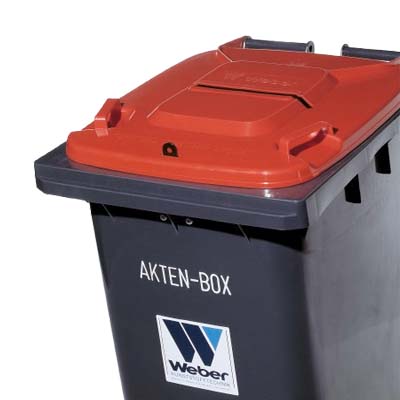
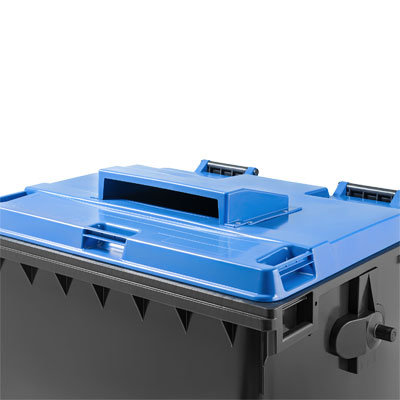
Paper slot – 2-wheel wheelie bin (file box) and 4-wheel flat-lid container
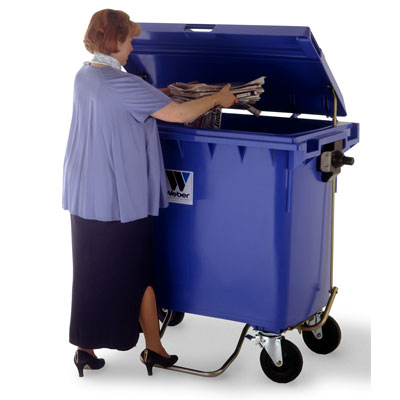
The paper slot in the lid, also available with a protective hood, allows documents, paper and envelopes to be deposited without opening the lid. This version is used as a file box for document disposal in offices, public authorities and public areas, but also in multi-occupancy residential buildings. The narrow aperture also prevents bulky foreign matter from entering the paper fraction. The paper slot must be combined with a lock system.
Lid apertures · bottles
Apertures for bottles and drink cans
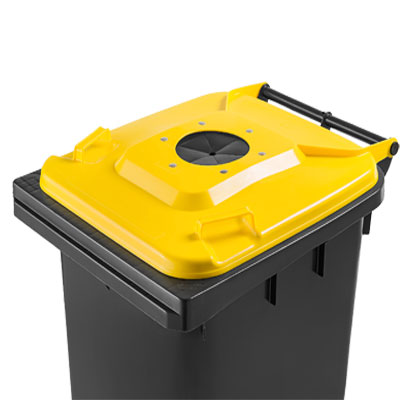
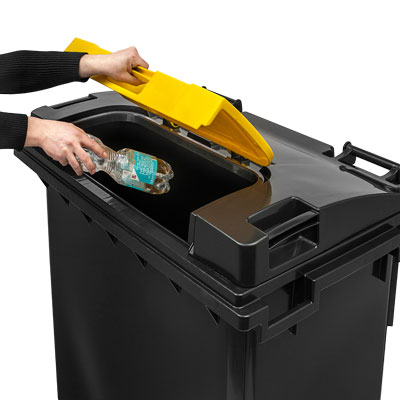
Bottle aperture – 2-wheel wheelie binsRound bottle aperture with rubber seal in the lid – 2-wheel wheelie binsBottle apertures – 4-wheel waste containers
Round aperture for bottles and drink cans — 2-wheel wheelie bins
Circular aperture for glass bottles on a 2-wheel wheelie bin. Depending on the lid size, the aperture diameter is available as Ø 90, 120 and 160 mm. A rubber seal can be added to close the aperture, reduce odour emissions and keep insects out.
Double bottle aperture — 4-wheel waste containers
Two circular bottle apertures (Ø 160/200 mm each) side by side in the lid of a 4-wheel flat-lid container. The double version suits busy glass collection points, for example in catering areas, hotels or retail environments. A single aperture would result in uneven filling of the container.
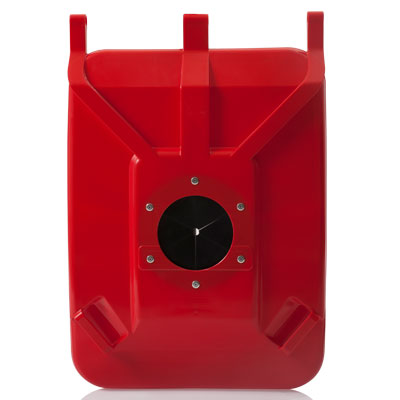
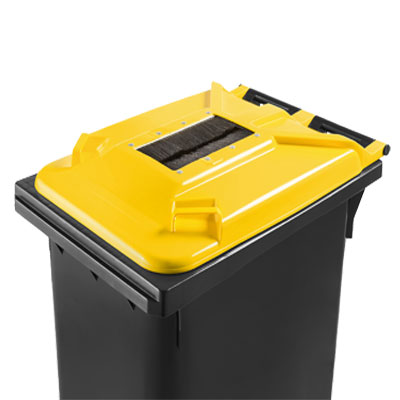
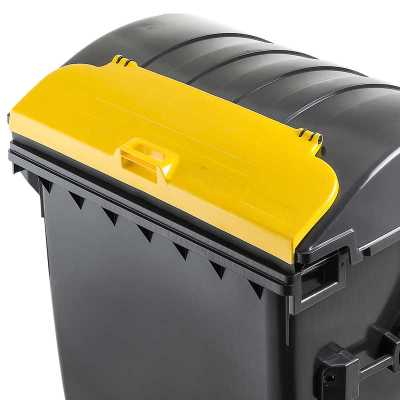
The brush aperture uses stiff bristles across the opening. Packaging such as cartons, plastic bottles and film can be pushed through. Lightweight items are not sucked back out by the wind. This version suits collection points and retail sites with high volumes of packaging.
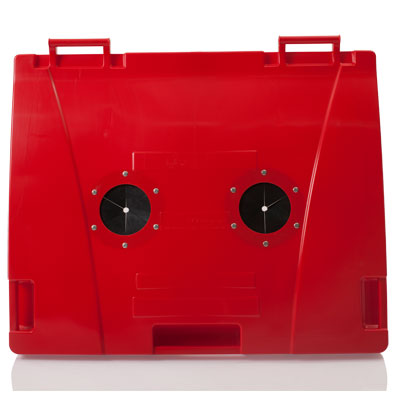
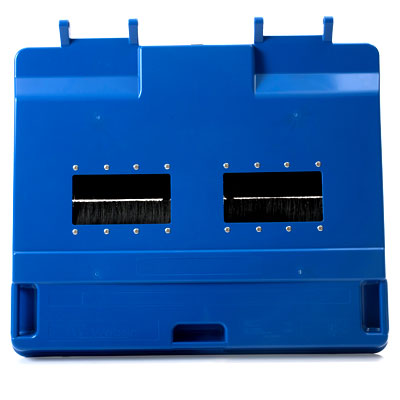
Double brush aperture — 4-wheel container
Two brush apertures in the lid of a 4-wheel container for disposing of larger quantities of packaging waste. The bristles allow lightweight packaging to be pushed in while preventing the wind from sucking material back out of the container. This configuration suits shopping centres, collection points and outdoor event areas.
Lid apertures · 4-wheel
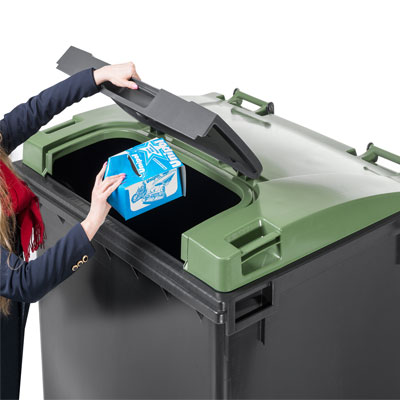
Lid-in-lid versions — for all Weber 4-wheel containers (660–1100 L)
The front lid is designed as a fully integrated hinged flap. Available for all Weber 4-wheel containers with flat lid and the 1100 L round-lid container.
Lid opener & foot pedal for 2- and 4-wheel plastic waste containers
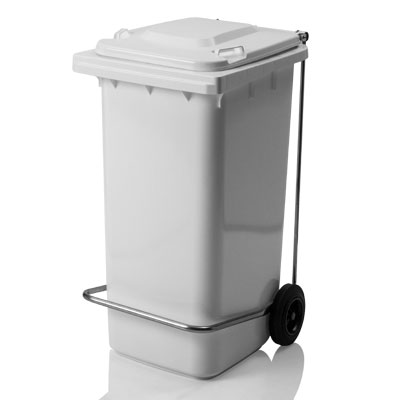
The foot pedal lid opener is available for 2-wheel containers in the sizes 80 L, 120 L and 240 L and for 4-wheel plastic waste containers from 660 to 1100 litres. Pressing the pedal with the foot opens the container lid fully, so waste can be deposited without touching the lid or the container body. The mechanism is factory-fitted and works without electrical power.
Lid opener · 2- and 4-wheel
Foot pedal lid opener
Lid opener with foot pedal – 2-wheel plastic wheelie binsLid opener with foot pedal – 4-wheel plastic waste containersLid opener – mechanism
The foot pedal mechanism consists of a steel rod running from the pedal at the lower edge of the container to a lever arm at the lid hinge. On 4-wheel containers, a return spring assists closing when the pedal is released. Under normal operating conditions, no regular maintenance is required.
RFID transponder / chip nest for plastic waste containers
A chip nest for an RFID transponder in accordance with EN 14803 is standard on all Weber 2- and 4-wheel plastic waste containers. The chip nest is moulded into the container body at a defined position in the comb lift and accepts commercially available transponders with an M30 thread, which municipal waste management companies use for route management, weighing data capture and billing systems.
Weber offers the supply and fitting of all transponder types common in waste management – optionally also with barcode labels. The RFID codes can be scanned at the factory and supplied as a file, also in combination with a container number.
Printing & marking of plastic wheelie bins and waste containers
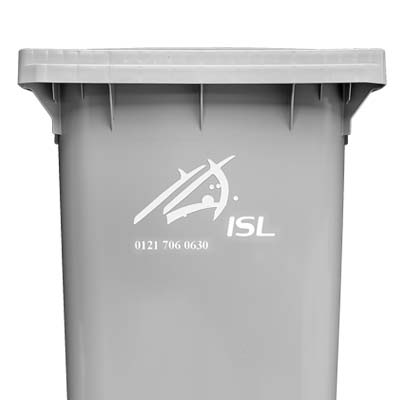
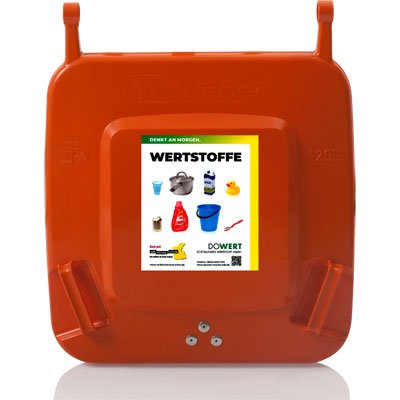
Weber offers hot-foil stamping, transfer printing and in-mould lid embossing as factory-integrated marking options for 2- and 4-wheel plastic waste- and recycling containers. All processes produce permanent, weather-resistant marking on the container body and/or lid. The marking is applied during production.
Printing & marking · hot-foil stamping
Hot-foil stamping — 2-wheel and 4-wheel wheelie bins
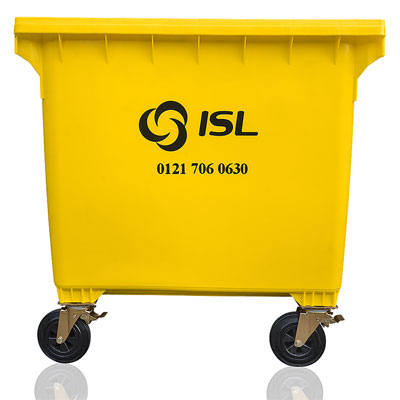
Single-colour hot-foil print on the flat top of the wheelie bin lid and on the front of the body of a waste and recycling container. The print area can carry logos, waste stream symbols, address text or numbering and is suitable for identifying waste streams in public collection or for your company logo. The print colour is determined by the foil used and matched to the container's colour. The marking is resistant to UV radiation, rain and usual cleaning. The print is clearly visible when the wheelie bin stands at the kerbside or in a bin storage. The process is also suitable for marking the containers with consecutive container numbers on the front and back.
Printing & marking · transfer printing
Transfer printing on body and lid
More complex consecutive numbering, also in combination with barcodes, can be applied to container bodies or lids by transfer printing. The process is also suitable for applying smaller, detailed markings, for example complex logos or QR codes.
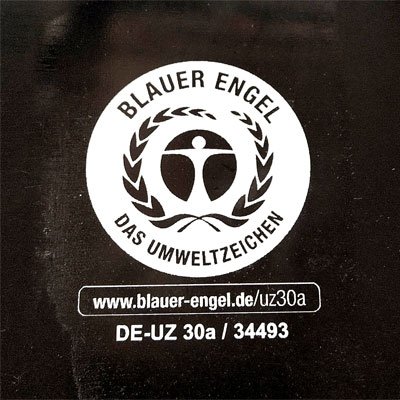
Transfer printing – static: The same design is printed on every container in a series, for example the “Blue Angel” ecolabel (Der Blaue Engel) for products made from recycled plastics (DE-UZ 30a), a company logo or a user instruction.
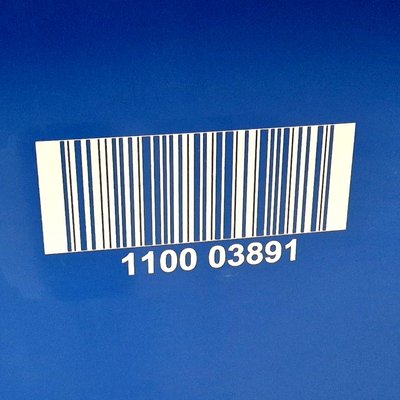
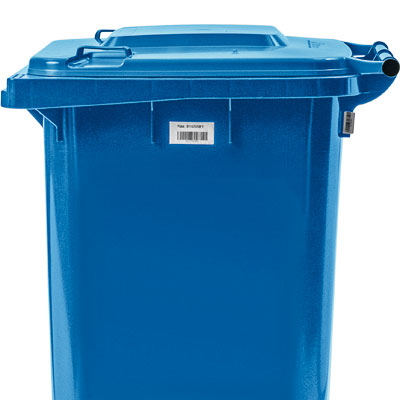
Transfer printing – consecutive number with barcode: Each container receives its own consecutive container number with a machine-readable barcode. This allows the containers to be clearly assigned, recorded and managed.
Printing & marking · in-mould lid embossing
In-mould lid embossing
All lids have areas in which customer-specific in-mould embossing can be applied. This allows years, company logos, addresses and user instructions to be permanently embossed.
Printing & marking · stickers
Stickers for 2- and 4-wheel wheelie bins
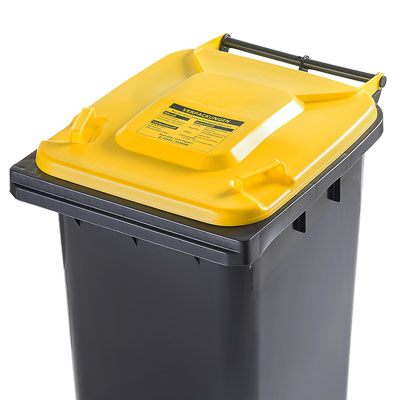
Weber offers to apply your stickers – whether company logos, waste stream labels or user instructions – during the manufacture of your containers.
The stickers can be applied to the lid or to the body of 2- and 4-wheel wheelie bins – for example as a sorting guide for recyclables directly on the lid or as a barcode sticker with the container number on the body. The containers thus leave the factory already labelled. Our sales team will advise you on positions and quantities.
Lifting systems for 4-wheel plastic waste containers
Depending on the vehicle technology, different standardised lifting systems are used. Weber produces containers with a comb lift as standard and offers lifting trunnions or Ochsner lifting systems for side lifting in accordance with EN 1501-5 as an option. The choice depends on the vehicle fleet used, and the collection method required.
Lifting systems · side lifting trunnion
Side lifting trunnion
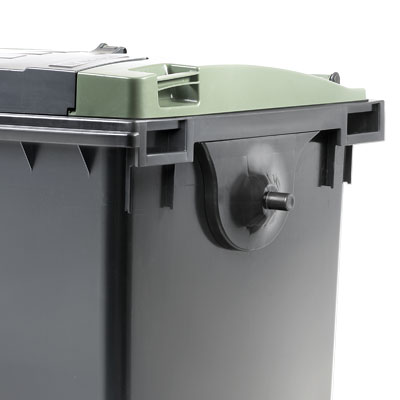
The side lifting trunnion is a pin on the outer wall of the container. It is inserted into the lifting fork. The trunnion body is reinforced with a steel insert to absorb the lifting forces during mechanical emptying of full containers. Design in accordance with EN 1501-5. Available for 660 L and 1100 L.
Lifting systems · reinforced side lifting trunnion
Side lifting trunnion — reinforced version
The side lifting trunnion in accordance with EN 840-2/3 is also available in a reinforced version. The design supports the side walls and prevents the container from deforming under heavy loads in the bin lifter.
Lifting systems · Ochsner lifting system
Ochsner lifting system
Ochsner handles are bolted metal brackets on the side walls of the container. They are used by collection vehicles with an Ochsner lifting system. Available on request for 660 L, 770 L and 1100 L flat-lid containers.
Lifting systems · safety stopper
Lifting trunnion with safety stopper (stop disc)
The safety stopper is a stop disc bolted to the lifting trunnion preventing the container from slipping out of the lifting device during tipping, e.g. if the bin lifter is not adjusted correctly or shows signs of wear. This reduces the risk of a container falling out of the bin lifter during emptying, especially on uneven ground, when the collection vehicle is standing on a slope or with heavily loaded containers.
Wheels and castors for 2- and 4-wheel plastic waste containers, lifting handles
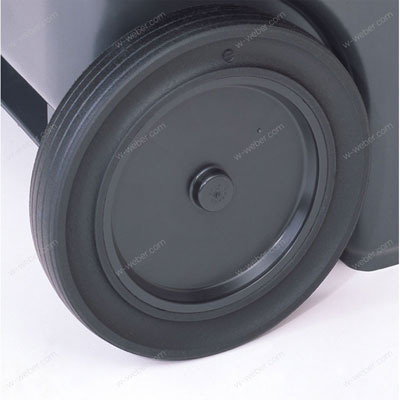
The standard wheel for Weber 2-wheel plastic waste containers is a solid rubber wheel made from recycled raw materials with a diameter of Ø 200 mm on a galvanised tubular steel axle with closed ends. For applications where this standard is not sufficient, Weber offers alternative wheel diameters and solid axles. For 4-wheel waste and recycling containers there is a wide choice of special castor variants. The following selection shows the most important options available.
2-wheel wheelie bins
Wheels · 2-wheel
Wheels with Ø 250 mm and Ø 300 mm
Wheels with Ø 250 mm are available for 140 L, 180 L and 240 L wheelie bins. A wheel with Ø 300 mm can be fitted to the 360 L container. The larger diameter improves mobility on gravel, paving and uneven outdoor surfaces. All options use the same axle as the standard Ø 200 mm wheel.
4-wheel waste containers (660–1100 L)
Wheels · central brake
Central brake system — 4-wheel containers
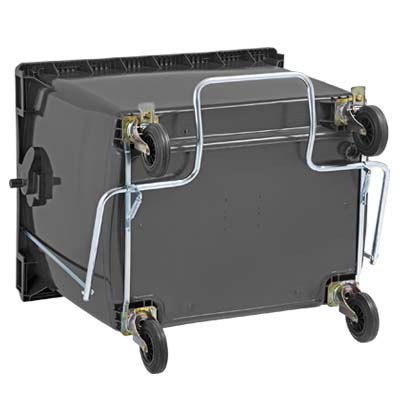
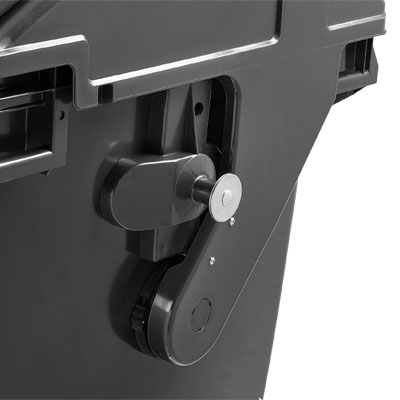
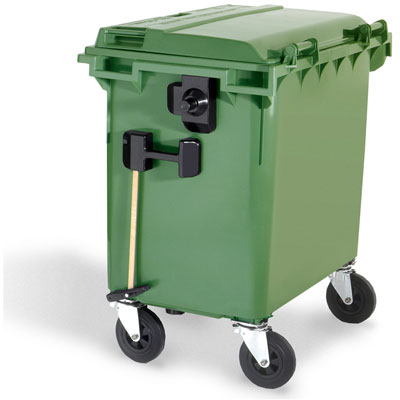
The central brake system operates two of the four castors simultaneously via a mechanical linkage. The brake is applied by pressing a foot pedal on the right-hand side of the container. It is released with a triangular key on the right-hand side handle. The central brake is used for better ergonomic handling of the containers.
Chassis · 4-wheel
Side lifting handles — 4-wheel waste containers
Side lifting handles (right and left) make it easier to lift and manoeuvre the waste container. With the central brake system, the lifting handles are included in the scope of delivery.
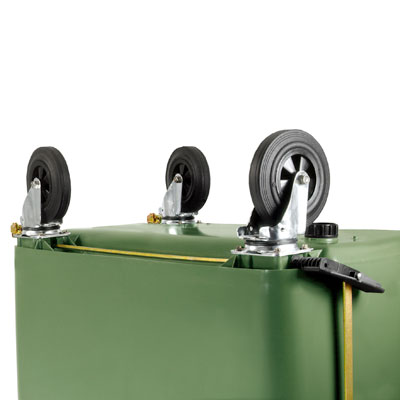
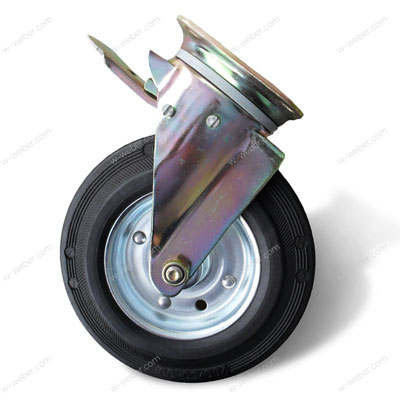
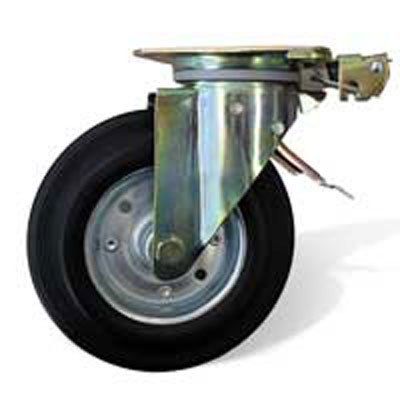
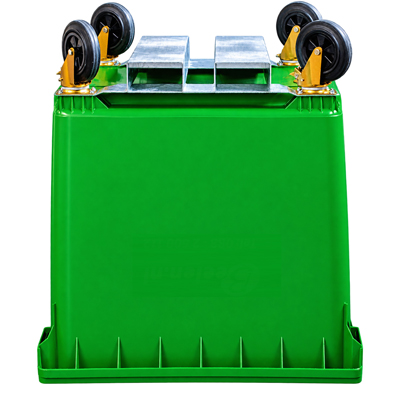
Weber offers three special castor types for 4-wheel containers: heavy-duty castors with steel rim and ball or roller bearings for higher loads or longer transport distances; non-marking rubber wheels for sealed indoor floors in production, clean rooms or food areas; and polyamide wheels for environments with chemical exposure or special temperature requirements.
Wheels · directional lock
Directional lock
Directional locks are fitted to two of the four castors to stop them swivelling to block them in one direction. This improves straight-line running when pushing the container and prevents it from veering sideways when towed. Directional locks are a prerequisite for the safe use of a tow bar system. Available for all 4-wheel containers.
Tow bar systems, forklift pockets and transport aids for plastic waste containers
For sites where several 4-wheel containers have to be moved at the same time, Weber offers a tow bar system for coupling several containers, forklift pockets for transport with industrial trucks, and an unloading frame and a destacking aid for forklift use.
Tow bars & logistics · forklift
Forklift pockets — 4-wheel waste containers
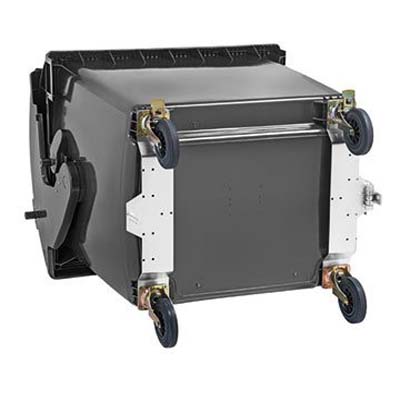
Forklift pockets are galvanised steel attachments on the container base. They allow a single 4-wheel container to be picked up and transported by forklift. They are used at transfer stations, recycling centres and industrial plants where containers are moved and emptied by forklift. Available for Weber 660 L, 770 L and 1100 L flat-lid containers.
Tow bars & logistics · tow bar system
Tow bar system — moving several 4-wheel containers
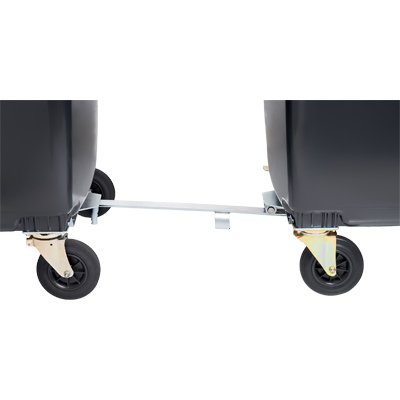
The tow bar system consists of a coupling system that connects several 4-wheel containers one behind the other to form a train. A towing vehicle moves the entire container train in one operation. Directional locks on two castors per container ensure straight-line running. This solution is used in large residential complexes, hospitals and industrial plants when groups of containers are moved over longer distances.
Tow bars & logistics · unloading
Forklift unloading frame
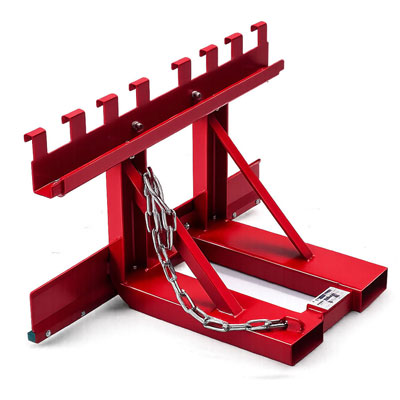
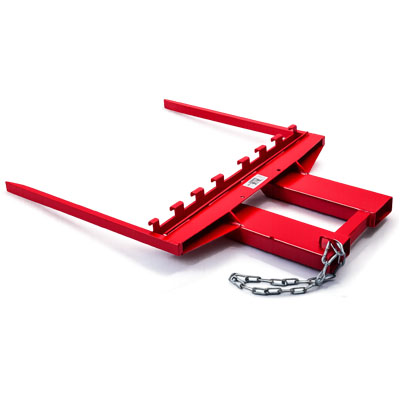
The forklift unloading frame is a container pick-up comb that is slid onto standard forks and secured against slipping with a chain. This allows a forklift to lift and move a stack of empty 2-wheel wheelie bins in operation. This reduces handling time and the risk of accidents when unloading and distributing new containers or returning them after servicing.
Tow bars & logistics · destacking
Forklift destacking aid
The destacking aid is a flat steel frame that is mounted on the forks and slid between two stacked wheelie bins. A chain with a safety catch secures the frame to the forklift. Destacking 4-wheel containers is considerably more ergonomic with the destacking aid.
Special equipment — compatibility overview
All container sizes from 60 L to 1100 L. Scroll horizontally on small screens.
✓Available as an option
SStandard (included)
—Not available
FL = flat lid · RL = round lid · LiL = lid-in-lid · FL C = flat lid Classic
Compatibility of Weber options with container sizes from 60 L to 1100 L
Option
Specification
Photo
60/80 L
120 L
140/180 L
240 L
360 L
660/770 L
1100 FL
1100 FL LiL
1100 FL C
1100 RL
1100 RL LiL
Lid apertures
Lid apertures
Bottles Ø 90/120/160 mm ± rubber collar
✓
✓
✓
✓
✓
✓
✓
—
✓
—
—
Lid apertures
Bottles Ø 160/200 mm ± rubber collar (2×)
—
—
—
—
—
✓
✓
—
✓
—
—
Lid apertures
Paper slot
✓
✓
✓
✓
✓
✓
✓
—
✓
✓
—
Lid apertures
Packaging aperture with brushes
—
—
—
✓
✓
✓
✓
—
✓
—
—
Lock systems
Lock
Triangular lock
✓
✓
✓
✓
✓
✓
✓
✓
✓
✓
✓
Lock
Gravity lock
✓
✓
✓
✓
✓
✓
✓
✓
✓
—
—
Lock
Profile cylinder lock
—
—
—
—
—
✓
✓
✓
✓
—
—
Lock
Padlock bracket
—
✓
✓
✓
✓
✓
✓
✓
✓
✓
—
—
Lid opener
Lid opener
With foot pedal
80 L
✓
—
✓
—
✓
✓
✓
✓
✓
✓
Lifting systems
Lifting system
Comb lift (standard)
—
S
S
S
S
S
S
S
S
S
S
S
Lifting system
Side lifting trunnion (EN 1501-5)
—
—
—
—
—
✓
✓
✓
✓
✓
✓
Lifting system
Lifting trunnion with safety stopper
—
—
—
—
—
✓
✓
✓
✓
✓
✓
Lifting system
Ochsner lifting system
—
—
—
—
—
✓
✓
✓
✓
—
—
Container marking
Marking
In-mould lid embossing
—
✓
✓
✓
✓
✓
✓
✓
✓
✓
✓
✓
Marking
Hot-foil stamping on container body and lid
✓
✓
✓
✓
✓
✓
✓
✓
✓
✓
✓
Wheels & chassis
Wheels
Ø 200 mm (standard)
—
S
S
S
S
S
S
S
S
S
S
S
Wheels
Ø 250 mm
—
—
✓
✓
—
—
—
—
—
—
—
Wheels
Ø 300 mm
—
—
—
—
✓
—
—
—
—
—
—
Wheels
Heavy-duty / non-marking / polyamide
—
—
—
—
—
✓
✓
✓
✓
✓
✓
Wheels
Castor with steel rim and ball bearings
—
—
—
—
—
✓
✓
✓
✓
✓
✓
Wheels
Directional lock
—
—
—
—
—
✓
✓
✓
✓
✓
✓
Wheels
Central brake
—
—
—
—
—
✓
✓
✓
✓
✓
✓
Tow bar system
Tow bar system with directional locks
—
—
—
—
—
✓
✓
✓
✓
✓
✓
Forklift
Forklift pockets (galvanised steel attachment)
—
—
—
—
—
✓
✓
✓
✓
—
—
Identification & handling
RFID
Chip nest for transponders in accordance with EN 14803
Can options be retrofitted to an existing Weber waste container?
That depends on the configuration and the option. Some options can easily be retrofitted later by the user. For others, this is either uneconomical or technically not possible. Our team will be happy to help.
Are Weber container options compatible with containers from other manufacturers?
The options described on this page apply exclusively to plastic waste containers manufactured by Weber. Positions and design are matched to Weber's own moulds to ensure safe and intended use.
What is the minimum order quantity for custom hot-foil stamping?
The marking options vary by type of container. Please contact our sales team regarding marking positions and minimum quantities, or contact us directly for a quote: +49 2129 9362-0.
Are Weber containers approved for clinical and medical waste?
Yes. Weber manufactures waste containers from 240 L to 1100 L with ADR/RID approval for UN type 4H2, packing groups II and III. These containers are suitable for the collection, storage and transport of (bio)medical waste (n.o.s.) with the UN classification UN 3291.
Factory-fitted options for Weber waste containers – available when ordering
Certifications: EN 840 · CE marking · ISO 9001 · GS mark · ADR/RID
Weber fits all options directly during injection moulding and assembly at the Haan production site. Many special features cannot be added after manufacture. The standard range includes RFID transponders in accordance with EN 14803, hot-foil stamping, triangular and gravity locks, paper slots and bottle apertures from Ø 90 to 200 mm, foot pedal lid openers for 2- and 4-wheel containers, side lifting trunnions in accordance with EN 1501-5, heavy-duty and non-marking castors, and tow bar systems with coupling bars.